
TLDR: A supposed cancer survivor who fought cancer twice and never stopped his IT consulting job sells organ supplements with zero proof of what's inside them. A company with two simultaneous presidents (and no scientists) promises "true to science" products. And the industry leader refuses to show test results to "protect trade secrets." Welcome to the $551M organ supplement market, where Amazon marketers are suddenly experts in processing animal organs. If you are anything like me and longing for nutrient-packed superfoods that are easy to consume you probably were sold on organ supplements too. But here's what you need to know before making any purchases.
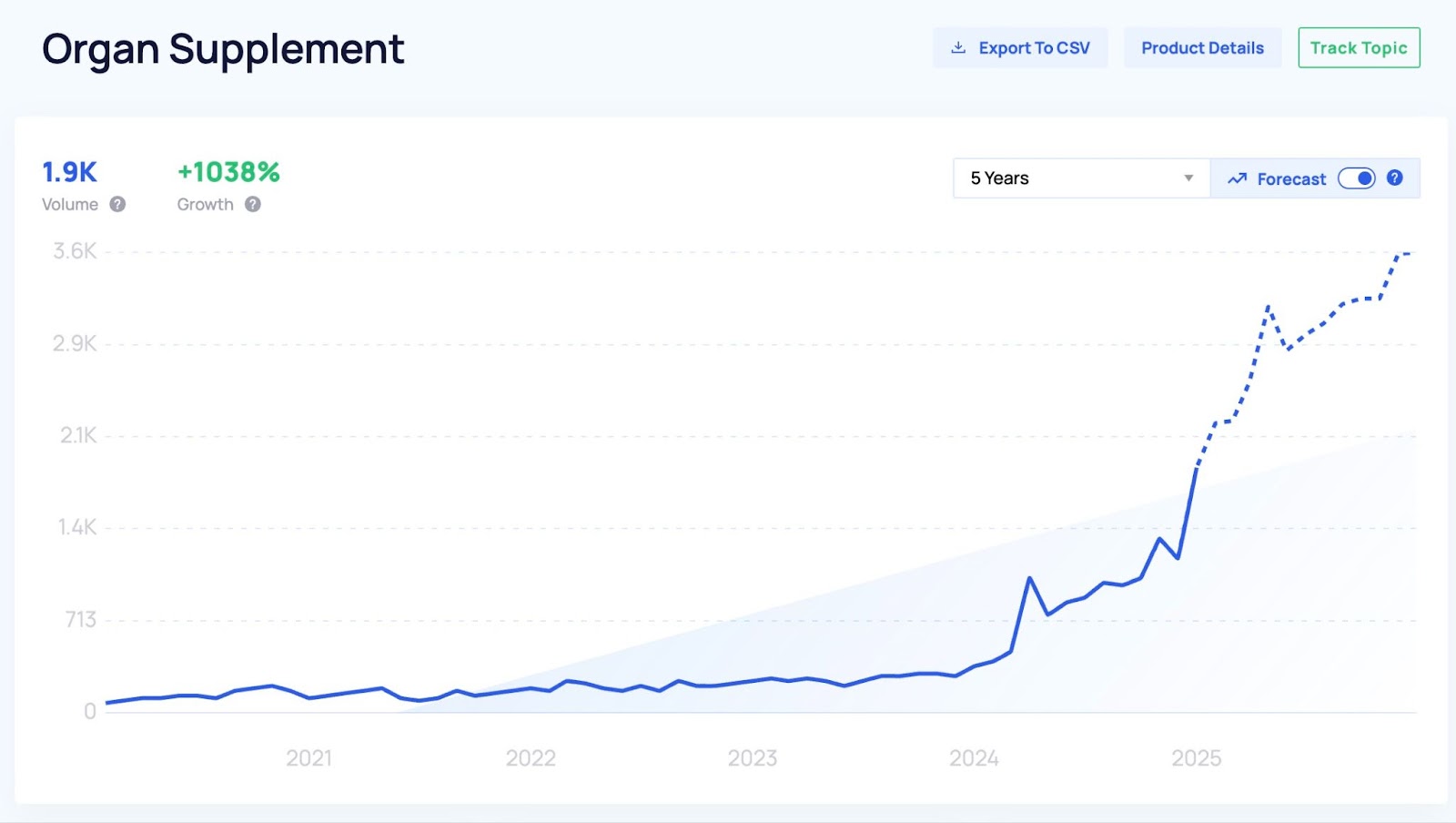
Disclaimer: I discovered this trend using Exploding topics (I am an affiliate and a long-time fan of this tool), which has become my go-to resource for uncovering under-the-radar opportunities. While the tool doesn’t provide the research that comes with my newsletter, if you're into finding even more trends in all the fields, this tool is definitely worth a look.
Table of Contents
Meet your organ supplement sellers
Organ supplements aren't some groundbreaking innovation — they're literally dried and powdered animal organs in a capsule. Yet somehow, this simple process has created a market that's projected to reach $811 million by 2030.
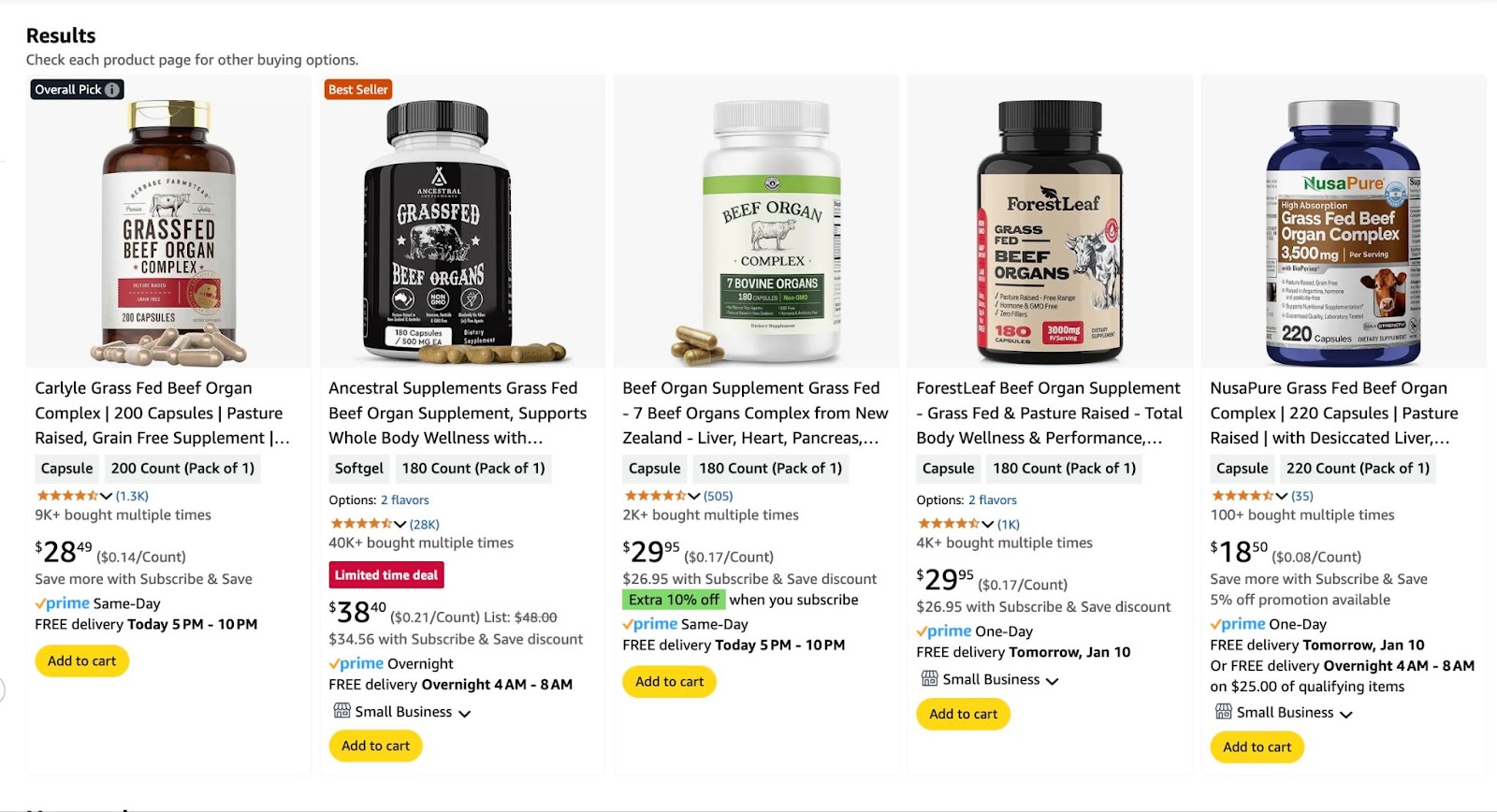
When you search for "organ supplements" on Amazon, you'll find over 2,000 results promising concentrated organ nutrition without the taste. Let's look at the top five sellers — what I found after digging into their backgrounds speaks volume about this industry.
Carlyle, or is it Herbage Farmstead?
First up is "Grass Fed Beef Organ Complex" — selling for $0.14 per capsule under their "Herbage Farmstead" brand, with over 4,000 monthly purchases. But try finding Herbage Farmstead, and you'll land at Carlyle Nutritionals instead.
Their website screams "marketing first, quality later" — packed with discount popups and giant discount banners. They've got this "Quality" page that had me excited for about three seconds, until I found nothing but vague promises about "exceptional standards" and "finest ingredients."
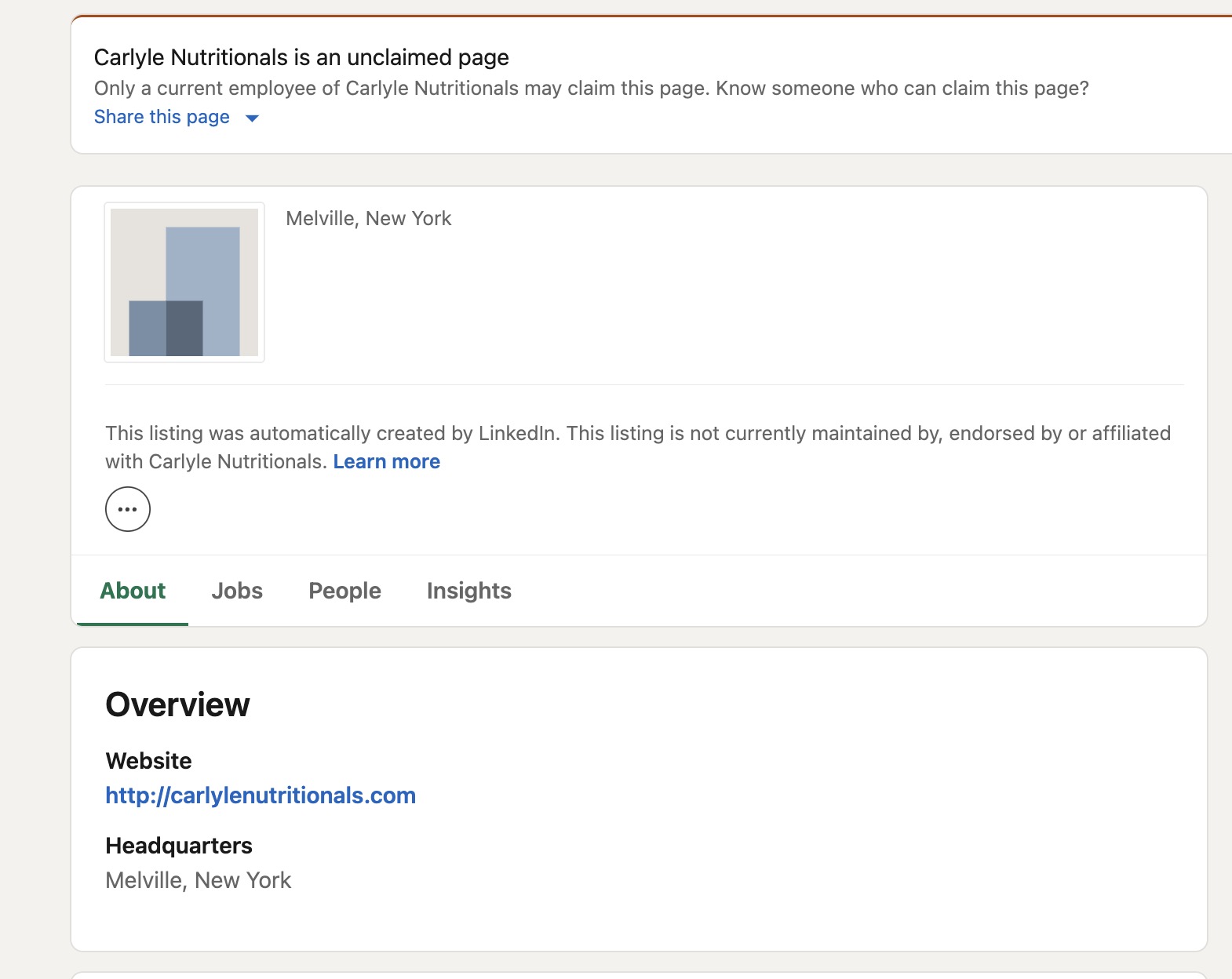
The marketing copy is something else: "We source the finest ingredients around the world from suppliers that share our passion for excellence." Their products are supposedly "expertly crafted" in USA facilities and "put to the test in our world class lab." But who's running these tests? Their LinkedIn page is basically empty.
Even their return policy raises eyebrows. Sure, they offer a 30-day refund, but you're paying shipping, they're not responsible if it gets lost, and — my favorite part — they "reserve the right to change our return policy at any time." For a company claiming "three generations of expertise," they sure make it hard to trust them.
Ancestral Supplements: The Liver King's enterprise
At $0.19 per capsule and 10,000+ monthly purchases, Ancestral Supplements are both the most expensive organ supplements from this analysis and also the best-selling ones. Their website makes all the tempting claims: grass-fed New Zealand beef, hormone-free processing, third-party testing. So on paper, they look more established than most. There's Brian Johnson (aka "Liver King") as the owner, with his vocal presence in the organ supplement world. And their CEO, Chris Ricci, actually brings some industry cred with four years running operations at Ancient Nutrition.
Their manufacturing process page paints a perfect picture: carefully selected grass-fed animals from New Zealand and Australia, gentle freeze-drying without fillers, rigorous third-party testing. One small issue: there's not a single photo, video, or test result backing any of these claims.
I know this firsthand because a few months ago, their marketing almost convinced me to buy. But since there was no documentation on the website I emailed them asking for those third-party test results. Their response?
No proof, because sharing the test results might reveal "trade secrets" to competitors. Right. Because showing that your products are safe and contain what you claim would somehow give away the farm.
Left Coast: Lyme disease turned into a construction business
Left Coast sells their organ complex for $0.15 per capsule, with about 1,000 bottles moving monthly. Their website reads like every other supplement company: premium keto products, collagen, MCT oils, bone broth — all with those familiar "clean label" and "money-back guarantee" promises they never actually validate.
The company's origin story, told on their "About" page, checks every marketing box. According to founder Simon Thompson, he started the company while battling Lyme disease after getting frustrated with MCT oil labels showing "Palm and/or Coconut Oil." So he launched Left Coast to "provide the highest quality Keto products at the best price."
Well, funny enough, the company's LinkedIn page currently shows zero employees. And Thompson's LinkedIn profile shows he left the supplement business in December 2020. These days, he's running ST Fox Holding, acquiring construction companies in Canada. So who's actually making sure these organ supplements meet any quality standards? I looked, and I found nobody.
ForestLeaf: The case of the duplicate presidents
ForestLeaf charges $0.15 per capsule for their organ complex, moving 2,000+ bottles monthly. Their website could win an award for supplement industry clichés — discount popups, special offers, and products for everything from brain health to joint pain.
Their "About Us" page reads like AI wrote it: "In 2016, we set out with a clear mission: to craft supplements both true to nature and true to science." Looking for actual science? Good luck.
A LinkedIn search revealed just four employees — one person doing marketing, one — Amazon compliance. And there are also two co-founders, brothers, Hayim and Moishy Langer. Their careers are carbon copies: simultaneously presiding over the same companies, sharing board memberships, co-founding ForestLeaf. What's missing from ForestLeaf’s brief employees list? Anyone who knows anything about making supplements.
NusaPure: The IT consultant turned supplement seller
Coming in at just $0.08 per capsule (the cheapest of our top five), NusaPure has about 500 monthly purchases. Their marketing tells a compelling story about their founder, Cedric, supposedly a two-time cancer survivor who started the company after his recovery.
I found Cedric on LinkedIn — he's NusaPure's only employee and has zero supplement industry experience. His background? Two decades in IT services and SAP consulting. Nothing about science, food, nutrition, or manufacturing.
The timing of his story also raises questions. Based on his graduation year (1998), he would have been 26-27 when he claims to have first gotten cancer. During these supposed cancer battles in 2003 and 2014, his LinkedIn shows him running IT service businesses without interruption. While not impossible, it seems unlikely given the severity of the claimed conditions. And, well, most importantly, is there anyone in this company who knows how to create well-tested high-quality supplements? The answer is, sadly, no.
After researching organ supplements companies, I've found a consistent pattern: lots of marketing, minimal transparency, and almost no one with relevant expertise actually making these supplements. If there's a legitimate organ supplement manufacturer out there with real quality controls and transparency, I haven't found them yet. But I'm still looking — if you're that company, reach out and prove me wrong. I'll happily update this report.
Until then, keep in mind that you're not just buying supplements — you're trusting these companies with your health. And based on what I've found, most of them haven't earned that trust.
The science behind organ supplements
While I am still on the quest to find good organ supplements, let’s remind ourselves why someone would want to take them and start with what's actually proven: organ meats, especially liver, are nutritional powerhouses. According to USDA data, beef liver contains 658% of your daily vitamin B12 needs — compared to just 18% in regular grass-fed beef. Liver gives you 400% of your daily needs, while regular grass-fed beef provides 2%. Vitamin A? Liver hits 356% of your RDA, while beef contains zero.
All in all, organ meats are packed with so many nutrients that calling it a superfood almost feels like an understatement.
But while the nutrient density of organ meats is well documented, actual research on organ supplements is scarce. And some of the research on organ meats itself we do have is quite concerning.
Take this recent study on beef liver storage and cooking. Scientists found that even fresh liver starts developing potentially harmful compounds after just a few days in the fridge. At 7°C (pretty close to your average refrigerator temperature), histamine levels reached potentially dangerous levels after eight days.
Now think about this: if fresh liver needs such careful handling, what happens during the manufacturing process for these supplements? How long does it take to get from the animal to your pill bottle? None of the companies we looked into are disclosing this information.
The safety concerns get even more serious when you look at contamination risks. A study of organ meat markets found that 31.43% of samples tested positive for Salmonella — and that's in regulated markets where the meat is actually inspected. What about supplements manufactured who-knows-where by companies that won't even prove they do quality testing?
Why does this matter and what can you do?
The nutrients in organ meats are incredibly valuable. But turning those organs into supplements introduces a whole new set of problems and none of the supplements manufacturers I looked into while working on this report seem interested in addressing it transparently.
So what's the solution? If you want the benefits of organ meats, buy fresh from suppliers you trust. The supplement route might seem more convenient, but when you're buying from internet companies run by people with zero food safety experience and no verifiable quality controls, you're taking a big gamble with your health (and your wallet).
And look, I want to be wrong about this. So, if you're an organ supplement producer with actual proof of your safety protocols, quality of your sourcing, testing procedures and the nutritional contents of your product, reach out through the contacts on the author's page. I'd love nothing more than to update this guide with examples of companies doing it right. Until then, I'll stick to getting my organ meat nutrients the old-fashioned way — from actual organs sold by vetted vendors.


